Over $1 billion is the amount paid by short-term rental managers in commissions imposed by OTAs (Airbnb, Booking.com, VRBO) for repeat visitors who choose to book through the platforms rather than directly with the managers, according to a hostAI study.


Over 230,000 confirmed bookings in 2025 with 115 vacation rental companies, covering urban apartments, beach houses, mountain cabins, and resort destinations, indicate a systemic problem where operators pay OTA commissions for guests they themselves have acquired.


Specifically, repeaters account for 1% to 26% of the total booking value. The largest companies tend to see higher repeat visitor rates, likely due to their broader geographic reach, longer operating history, and more opportunities for visitors to return. In both cases, the local authorities receive 77% of the total booking value from repeaters, while the managers receive only 16%.

Research has named this phenomenon “repeat visitor leakage.” According to the research, direct bookings create three times more repeat customers than online travel agencies, which conflicts with the revenue they save.
However, 86% of first-time direct bookers will book directly again. 89% of first-time Airbnb bookers book again on Airbnb—unless they remember your name, in which case that number drops to 8%. Visitors to VRBO and Booking.com show a greater willingness to change the way they make bookings — 15-20% book directly for their next stay. These channels may attract more travelers looking for deals.
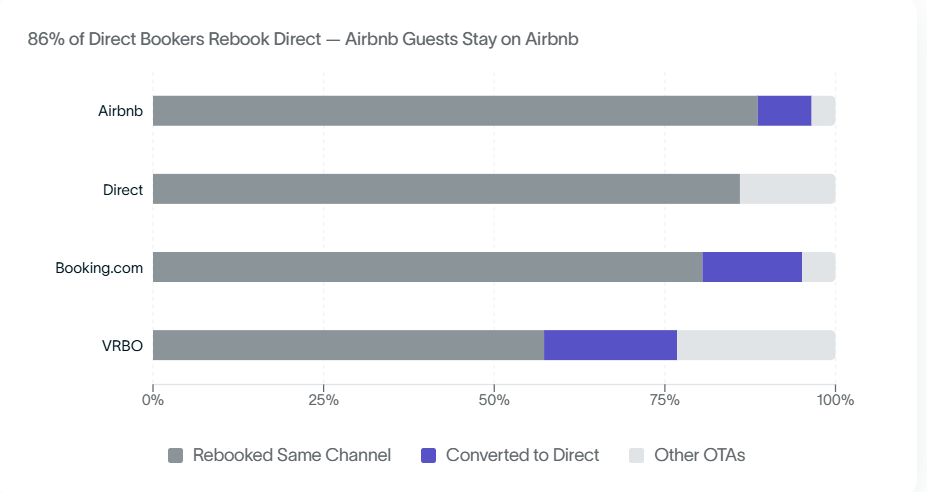
The largest portfolios have more repeat visitors, but more than 80% of these repeat bookings are made through OTAs. Small operators, often with more personal relationships with visitors, maintain more repeat visitors in their immediate ecosystem.
In simple terms, managers who rely almost exclusively on booking platforms lose the majority of their revenue from repeat customers in commissions. When direct bookings are below 5%, up to 87% of repeat guest revenue ends up with OTAs, while those with a strong direct booking channel (30% and above) limit this “leakage” to about 10%. This shows that investing in direct bookings is not just about avoiding commissions, but about the overall relationship with the visitor: a strong brand, better communication, and greater loyalty more easily lead to repeat bookings without intermediaries.
Why Loyal Guests Keep Rebooking Through Airbnb
For three reasons:
1. Brand Awareness Gap
Guests remember the property, not the operator. They recall “that amazing cabin in Tahoe” but not the company that managed it. When they’re ready to rebook, they search Airbnb — because that’s where they found it last time.
2. No Compelling Reason to Book Direct
Many operators offer identical pricing on OTAs and direct. Without a loyalty program, repeat guest discount, or exclusive perk, there’s little incentive to leave the familiar OTA booking flow.
3. Trust Asymmetry
Guests trust Airbnb’s cancellation policies, customer support, and payment protection. Direct websites — especially those that look dated or lack reviews — can create uncertainty.
Amirali Mohajer, CEO and founder of hostAI, said that many operators do not know how many of their visitors are repeat customers or why they continue to rebook through OTA.