-It is also reducing flights to Heraklion, where the charge is €6 per passenger, compared to around €23 for Fraport


-A response from Fraport is expected
-In Athens, it is cutting only one route
Ryanair announced the closure of its three aircraft Thessaloniki base and reductions in capacity at Athens Airport for Winter ‘26, resulting in the loss of 700,000 seats (-45%) and 12 routes for the upcoming Winter ’26 season. This devastating loss in off-peak winter connectivity is the direct result of the hopelessly uncompetitive costs charged at the German-run Fraport Greece monopoly and Athens Airport.


The Greek Govt. made the wise decision to reduce the Airport Development Fee (ADF) by 75% (from €12 to €3 per passenger) from November’24, which should have directly stimulated year-round connectivity and tourism across Greece. However, most Greek airports, particularly those run by Fraport Greece, refused to pass the tax cut onto passengers and instead have pocketed the tax cut for themselves. Since then, Fraport Greece have continued to increase charges, which are now +66% above their pre-Covid levels. Likewise, Athens Airport will hike charges this Winter.


Consequently, Greek airports are no longer competitive in the off-peak shoulder and Winter months, when the tourism industry’s reliance on low-fare connectivity is most acute. Ryanair has therefore been left with no choice but to reallocate capacity to more competitive countries like Albania, regional Italy, and Sweden where airports have passed on the savings from Govt. tax reductions.
Ryanair’s reduced Winter ‘26 schedule for Greece will result in:
- 3 based aircraft at Thessaloniki (-US$300m investment)
- 700,000 seats (-45% versus Winter ‘25)
- 12 routes (Thessaloniki to Berlin, Chania, Frankfurt-H, Gothenburg, Heraklion, Niederrhein, Poznan, Stockholm, Venice-T, Zagreb, and Athens to Milan-M, and Chania to Paphos)
- 2 airports closed (Chania and Heraklion)
The routes that are being discontinued are:
- Thessaloniki – Berlin
- Thessaloniki – Chania
- Thessaloniki – Frankfurt Hahn
- Thessaloniki – Gothenburg
- Thessaloniki – Heraklion
- Thessaloniki – Niederrhein
- Thessaloniki – Poznań
- Thessaloniki – Stockholm
- Thessaloniki – Venice Treviso
- Thessaloniki – Zagreb
- Athens – Milan Bergamo
- Chania – Paphos
Ryanair presented an ambitious growth plan to the Greek Govt. to grow traffic to 12m passengers per annum (+70%), base 10 additional aircraft (+US1bn incremental investment) and launch 50 new routes over the next 5 years. However, this growth can only be delivered if airport charges are frozen and the 75% Airport Development Fee reduction is passed on to passengers at all airports. Regrettably, Greece will continue to miss out on investment opportunities, tourism and traffic development until Fraport Greece and Athens abandon their shameless practice of pocketing this tax cut.
An indication of the unprofessional nature of the press briefing, which prompted journalists’ complaints, was the lack of invitations, the absence of interpretation services, and the distribution of the announcement on a single sheet of paper rather than via email.
Responding to a question from money-tourism.gr about why Ryanair does not adjust its schedules, as other airlines do, but instead creates such noise each time—sometimes with actions that border on insults—the company’s commercial director replied that “the company informs the public.”
It is worth noting that the airline is suspending flights to and from Heraklion, where the charge is just €6 per passenger, compared with around €23 charged by Fraport. Similarly, at Athens International Airport, it will suspend only one route (Athens – Milan Malpensa) for the winter season, yet it still refers to Athens Airport in its announcement.
Ryanair: Reduce costs to bring more flights
Ryanair is directly linking its continued presence and expansion in the Greek market to the level of airport charges, while presenting an ambitious growth plan for Greece. The company claims this could bring 12 million passengers annually, 10 additional based aircraft, €1 billion in investments, and 50 new routes over the next five years.
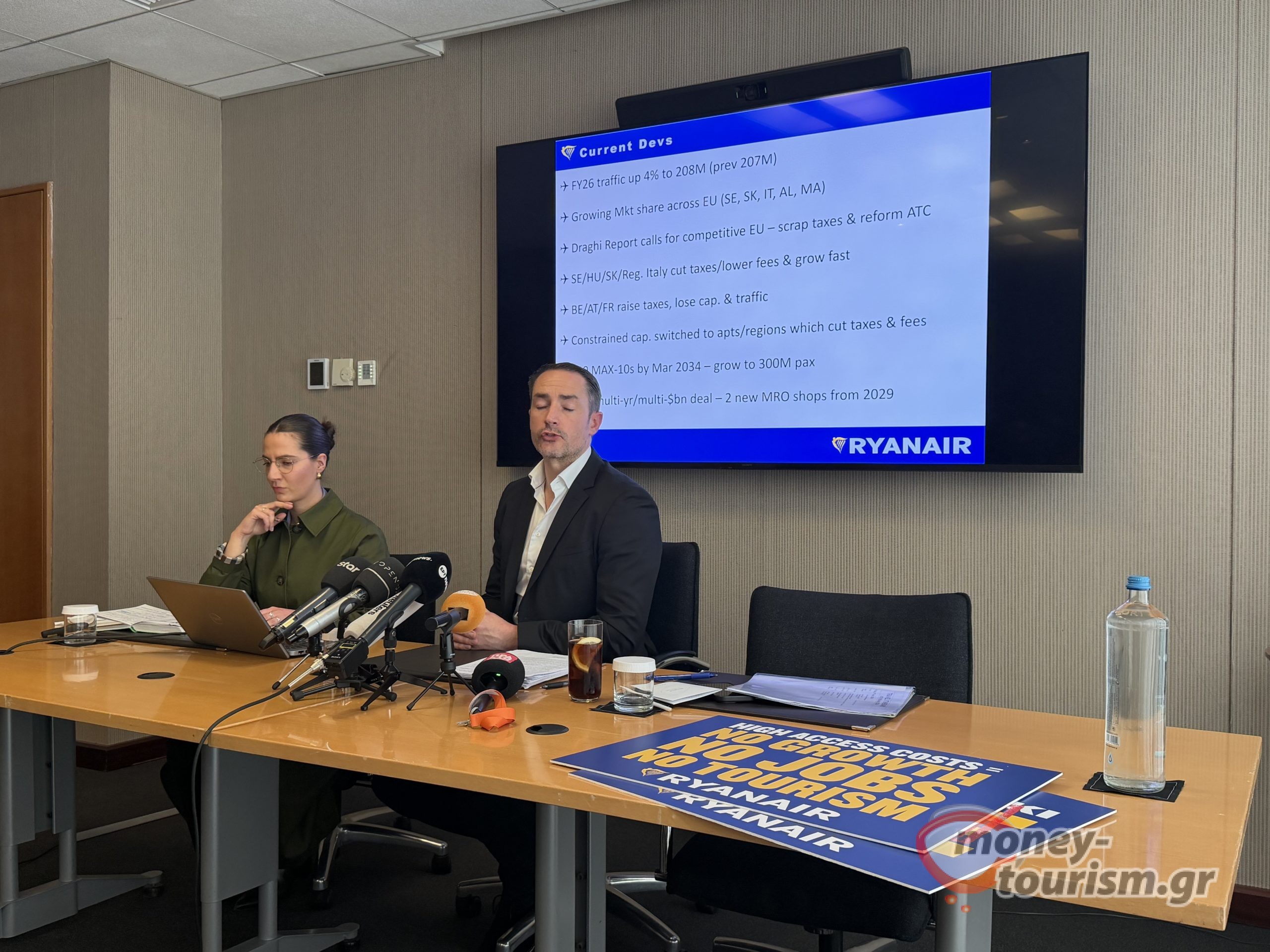
However, the airline makes clear that this is only possible if airport charges are reduced and the reduction of the ADF is fully implemented across all Greek airports.
Particularly sharp was the Chief Commercial Officer of Ryanair, Jason McGuinness, who openly accused Fraport Greece of monopolistic practices and argued that Greece is losing tourism, jobs, and air connectivity due to high charges.
He stated that Ryanair provided 90% of Thessaloniki’s international capacity last winter and warned that the withdrawal of aircraft would have serious consequences for the city, passengers, and winter tourism.
In practice, Ryanair is reviving its well-known pressure model, which it has consistently applied across many European countries and airports, linking the maintenance or expansion of its presence to more favourable financial terms and lower charges.
This strategy has been used repeatedly by the Irish airline in negotiations with governments, regions, and airport operators across Europe. While the company presents its key argument as boosting tourism and regional development through low-cost connectivity, it has often faced criticism for particularly aggressive and, at times, coercive negotiating tactics, as it has not infrequently announced departures, base closures, or route cuts in order to secure lower fees and financial incentives.
The timing is particularly significant for Greece, as the government, regions, and tourism stakeholders are strategically investing in extending the tourist season and strengthening winter air connectivity.

In particular, the development raises serious concerns for Thessaloniki, as the city has in recent years evolved into a key low-cost flight hub for Northern Greece, with Ryanair playing a significant role in winter international passenger traffic.
In the coming period, reactions from the government, Fraport Greece, Athens International Airport, as well as local tourism bodies and regional authorities are expected with particular interest, in response to Ryanair’s public claims and pressure.