


After two decades of planning, construction, and delays, the Grand Egyptian Museum (GEM) officially opens on Saturday, offering a unique blend of cultural heritage and architectural innovation.

A two-decade project
The museum’s concept began in 2005, but the political turmoil that followed the Arab Spring in 2011 froze construction for three years. The cost was approximately $1 billion, and the inaugurations were postponed several times, most recently in the summer of 2025 due to regional conflicts. Despite the obstacles, the Egyptian government considers this project a key tool for revitalizing tourism, an industry that provides vital foreign currency to the country.


The largest museum dedicated to a culture
The GEM houses more than 50,000 exhibits of ancient Egypt, making it the largest museum in the world dedicated to a single culture. For comparison, the Louvre in Paris exhibits approximately 35,000 works. From the vast 24,000 square meter building of permanent exhibition spaces, the complete Tutankhamun collection stands out, with 5,000 objects, which is presented for the first time in its entirety after the discovery of the tomb in 1922. Among them are the death mask, the golden death beds, the chariots, and the throne of the young pharaoh.



Architecture that converses with the Pyramids
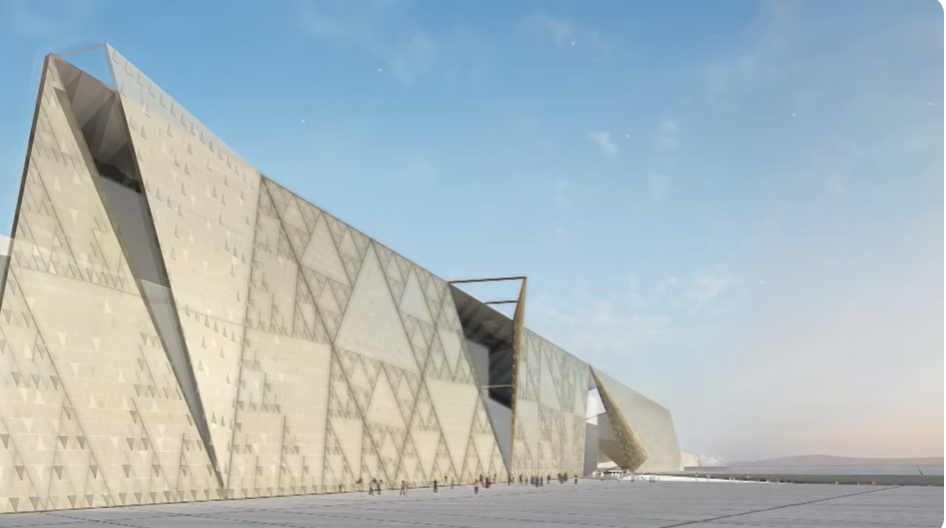
The museum was designed by the Irish Heneghan Peng Architects, who won the international competition in 2003. Located on the high plateau of Giza, the building is distinguished by the landscape: its triangular facade of alabaster stone reflects the geometry of the Pyramids, while the internal visual axes are aligned with them.
The lobby is dominated by the 11-meter-tall colossus of Ramses II, which was transported from the center of Cairo. From there, a monumental six-level staircase, framed by ancient statues, begins, leading to the main halls and offering a view of the Pyramids. A special passage connects the museum to the archaeological site, allowing visitors to move on foot or by electric vehicle.
Technology and maintenance
The museum’s rooms feature advanced presentation systems, such as mixed reality applications, to “translate” ancient culture to younger generations. The conservation center has already restored rare exhibits, including the golden sarcophagus of Tutankhamun and the 43-meter-long solar boat of Khafre, which was transported from Belgium in 2021 in a special vehicle.
Support for tourism
The Egyptian government aims to double the number of arrivals, reaching 30 million visitors by 2032. In 2024, 15.7 million tourists visited, and this year, authorities estimate that the new museum will attract 15,000–20,000 visitors per day. To facilitate access, new roads have been built, a subway station is being constructed next to the museum’s gates, and the new Sphinx International Airport, 40 minutes west of Cairo, has already been put into operation.
“A Museum for the 21st Century”
According to the museum’s CEO, Ahmed Ghoneim, “we use the language that Gen Z speaks, which is technology,” while Hassan Allam, head of the management company, said: “The world was waiting… everyone is excited.”
The Grand Egyptian Museum is not just an exhibition space; it is also an architectural landmark and a development tool that attempts to combine the grandeur of ancient Egypt with the demands of modern tourism.












 officially opens on Saturday)