With a direct contribution of €30.2 billion in 2024 – equivalent to 13% of GDP – the tourism sector demonstrates its leading role as a strategic pillar of growth, competitiveness, resilience and prospects of the Greek economy in an unstable and ever-changing international environment.


The figures come from the latest study by the Institute of the Association of Greek Tourism Enterprises (INSETE) on “The contribution of tourism to the Greek economy in 2024”, according to which if the indirect contribution of the sector is included, the corresponding percentage exceeds 30% of GDP. Tourism activity remains predominantly export-oriented, with 84.4% of receipts coming from inbound tourism, covering 71.5% of the goods balance deficit (-€35.66 billion in 2024). Furthermore, the sector contributed directly to the peak, in the third quarter of 2024, to 16.5% of employment.


The direct contribution of tourism
As regards the direct contribution of the sector for the previous year, it amounted to EUR 30.2 billion and is broken down into inbound tourism expenditure (EUR 21.6 billion including cruise passenger expenditure), air transport (EUR 2.9 billion), air transport (EUR 2.9 billion) and air transport (EUR 2.2 billion). (EUR 2.9 billion), maritime transport (EUR 147 million), cruise companies’ expenditure (EUR 799 million), domestic tourism (EUR 2.3 billion) and domestic value added from investments (EUR 2.5 billion). It should be recalled here that according to the first estimate of ELSTAT, the country’s GDP, at current prices, in 2024 stood at 237.6 billion euros increased by 5.5% compared to 2023.
The direct impact of tourism increased by 5.0% compared to €28.8 billion in 2023, with increases in all individual expenditures (inbound tourism, cruise, transport, domestic tourism, investment). It is worth noting that investment amounted to €5.1 billion, of which around €2.4 billion is estimated to be domestic value added.
The contribution of tourism extends throughout the economy
Based on the estimates of the multipliers from IOBE and KEPE, for every 1 euro of tourism activity, an additional 1.2 to 1.65 euro of additional economic activity is created. Essentially, for every EUR 1 of tourism revenue, the country’s GDP increases by EUR 2.2 to 2.65. Taking into account the multiplier benefits, the total contribution of tourism to the country’s economy in 2024 is estimated to be between EUR 66.5 billion and EUR 80.1 billion, figures corresponding to between 28.0% and 33.7% of GDP. The corresponding figures for 2023 were between EUR 63.3 billion and EUR 76.2 billion corresponding to between 28.1% and 33.9% of GDP.
A lever of opportunity and growth for the Greek region
With 77% of inbound tourism revenues generated outside Attica, tourism steadily boosts employment and regional development, contributing substantially to employment and income. South Aegean with a 28% share of receipts, Crete with 22%, Ionian Islands with 10% and Central Macedonia with 7% account for almost 2/3 (67%) of receipts, highlighting the potential for further diffusion of tourism activity to the other Regions.
In 2024, employment in the tourism sector recorded a 4.8% increase compared to 2023, reaching 401,000 workers, while in the third quarter (Q3) a record high of 451,400 people were employed – the highest number since the launch of the Labour Force Survey. This growth is particularly evident in the accommodation and food services sector, with increases starting at +9% in Q1 and remaining positive in all quarters. The increase is particularly strong in accommodation (+12% or +12,000 persons employed), but also in food services (+2% or +6,000 persons employed). Based on the assumption that accommodation and catering absorbs about 63.3% of tourism expenditure, it is estimated that at the peak of the season, tourism created up to 713,140 jobs, i.e. 16.5% of total employment in the country.
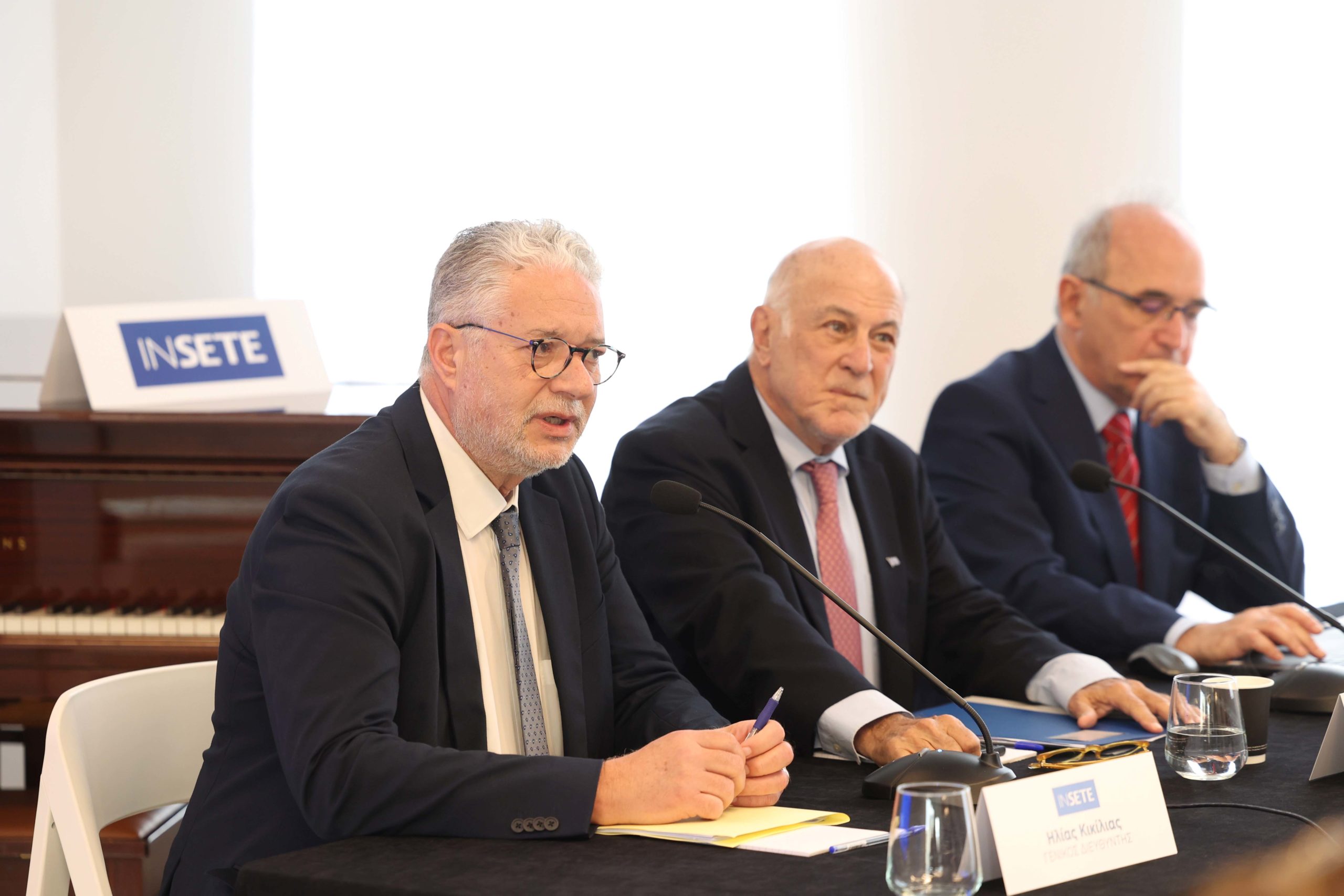
The report was presented on Tuesday 13 May, in the context of a press briefing during which the Secretary General of SETE and President of INSETE, Mr. George Vernicos refered: “The positive development of tourism in 2024 confirms its lasting contribution to the economy, at a time when nothing is taken for granted. The challenges are present both in the macro-environment – such as climate change, economic transformations, geopolitical instability – and in the everyday life of businesses. Many businesses, in mature and non-destinations alike, face marginal conditions due to insufficient financing, increased operational burdens and regulatory uncertainty. The sector, a long-standing pillar of the country’s growth, needs a consistent and supportive framework to continue to deliver. Its contribution is essential, but not self-evident.”