With global peace becoming an increasingly elusive goal, reaching a historic low this summer, the 2026 Global Peace Index (GPI), published by the Institute for Economics and Peace (IEP), takes on even greater significance. The report identifies the world’s most peaceful countries—those that offer the highest levels of safety and security for travellers.


The 2026 Global Peace Index (GPI) paints a picture of a world grappling with the economic consequences of a record-high number of conflicts, which are becoming increasingly interconnected and more difficult to resolve. This is also accompanied by a rapid technological revolution in the way wars are fought, leaving international law and diplomacy struggling to keep pace.




For the first time in history, machines are making life-and-death decisions on the battlefield faster than any human can assess them, while the international frameworks intended to regulate them are virtually non-existent.
The Index reveals
The Index reveals that the Global Peace Index (GPI) ranks 163 independent states according to their level of peace, covering 99.7% of the world’s population.
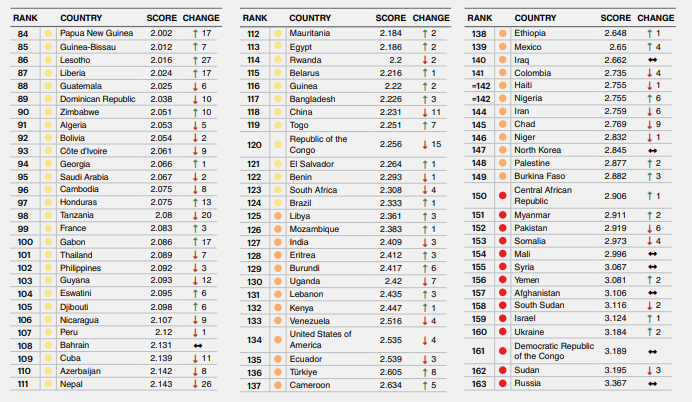
Key findings of the Index include:
- Global peace is at its lowest level since the inception of the Index, while the factors that precede major conflicts are worse than they have been since the end of World War II.
- Ninety-nine countries recorded a deterioration in peace over the past year, the highest number since the Index was first published 20 years ago.
- 119 countries, or 73%, are now less peaceful than when the Index was first released in 2007.
- The number of countries involved in external conflicts has nearly doubled, rising from 59 in 2008 to 103 in 2026.
- The global economic impact of violence increased by 3.2% to US$21.81 trillion in 2025, equivalent to 10.5% of global GDP.
- Drone strikes increased by 11,500% between 2018 and 2025, while artificial intelligence has reduced targeting times from one day to seconds.
- Deaths from global conflicts remain at historically high levels, with more than 181,000 fatalities in 2025—six times higher than in 2008.
- Led by Europe, global military spending reached a record US$2.9 trillion in 2025. Excluding the United States, military expenditure rose by 9.2%.
- Successful diplomacy preventing the resumption of war in Iran could generate approximately US$2.2 trillion for the global economy.
Iceland’s dominance
Iceland remains the world’s most peaceful country in 2026, a position it has held for 19 consecutive years, supported by the fact that it has no standing army and extremely low crime rates. The country tops the ranking by a significant margin, with a score of 1.161.
The top five most peaceful countries are completed by New Zealand, Switzerland, Slovenia, and Ireland.
New Zealand moved up one place from 2025 after recording the lowest score for ongoing conflicts of any country in the Asia-Pacific region, while Switzerland continues to be regarded as one of the world’s most stable and safest destinations. Meanwhile, experts consider Slovenia the most underrated country in the GPI top tier, with travellers perhaps being more familiar with neighbouring Austria and Croatia.
With a GPI score of 1.828, Greece ranks 53rd in the world, moving up two places, placing it among the ‘highly peaceful countries’.”
The ten most peaceful countries in the world in 2026 are:
- Iceland
- New Zealand
- Switzerland
- Slovenia
- Ireland
- Austria
- Portugal
- Singapore
- Finland
- Japan
The least peaceful countries in the world in 2026 are:
- Russia
- Sudan
- Democratic Republic of the Congo
- Ukraine
- Israel