Additional optional products offered to maintain lower base fares have contributed to a reduction in the total cost of air travel by approximately 40% since 2016, according to a new study conducted by IdeaWorks Company.


Complementary revenue from passengers paying extra for services such as luggage, seat selection, and in-flight meals is expected to reach $15.7 billion this year, up from $14.84 billion in 2024, and will be significantly higher than the $6.74 billion nearly a decade ago.


IdeaWorksCompany, a global consultant for airlines’ ancillary revenue, attributes the doubling of this amount to the steady increase in the number of passengers and the widespread adoption of basic economy fares by airlines worldwide. Complementary revenues now represent 15.7% of total airline revenues, up from 9.1% in 2016. This share ranges from 3.2% to 62% among individual airlines.
Meanwhile, the average airfare globally has been steadily decreasing over the last decade.
The average base fare for a one-way trip in 2016 was $294, with an additional $16 in surcharges, for a total of $310 (adjusted for inflation).
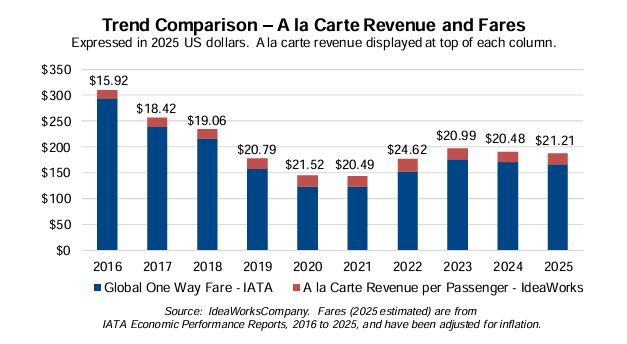
IATA estimates that the average base fare will be $166.38 this year, with IdeaWorks estimating $21.21 for optional extra fees, for a total of $187.59. This represents a 40% decrease in the total cost of air travel for consumers over a nine-year period, even with the increase in additional revenue, as noted by American IdeaWorks.
The basic economy fare was first introduced by low-cost airlines more than a decade ago as a way to attract travelers who are more price-sensitive.
These fares offered lower prices than ever before, with the option for passengers to add extras such as luggage, seats with extra legroom, and meals.
Major US airlines, such as American Airlines, Delta Air Lines, and United Airlines, later adopted this model, incorporating the basic economy seat as a service level into their existing operations.
“This innovation proved more successful than previous attempts by traditional airlines to establish separate low-cost subsidiaries,” said IdeaWorks. And he added: “The change was further accelerated by the reduction in business travel during the pandemic, which created a surplus of available seats. Seeing the success of large American companies, airlines around the world followed their example.
The company’s president and author of the analysis, Jay Sorensen, said: “While about 45% of travelers only purchase the base fare, more than 50% choose additional services, such as luggage, assigned seats, and in-flight services. This dynamic allows airlines to maintain lower base fares while providing travelers with more options and flexibility, resulting in a win-win for both consumers and airlines.”