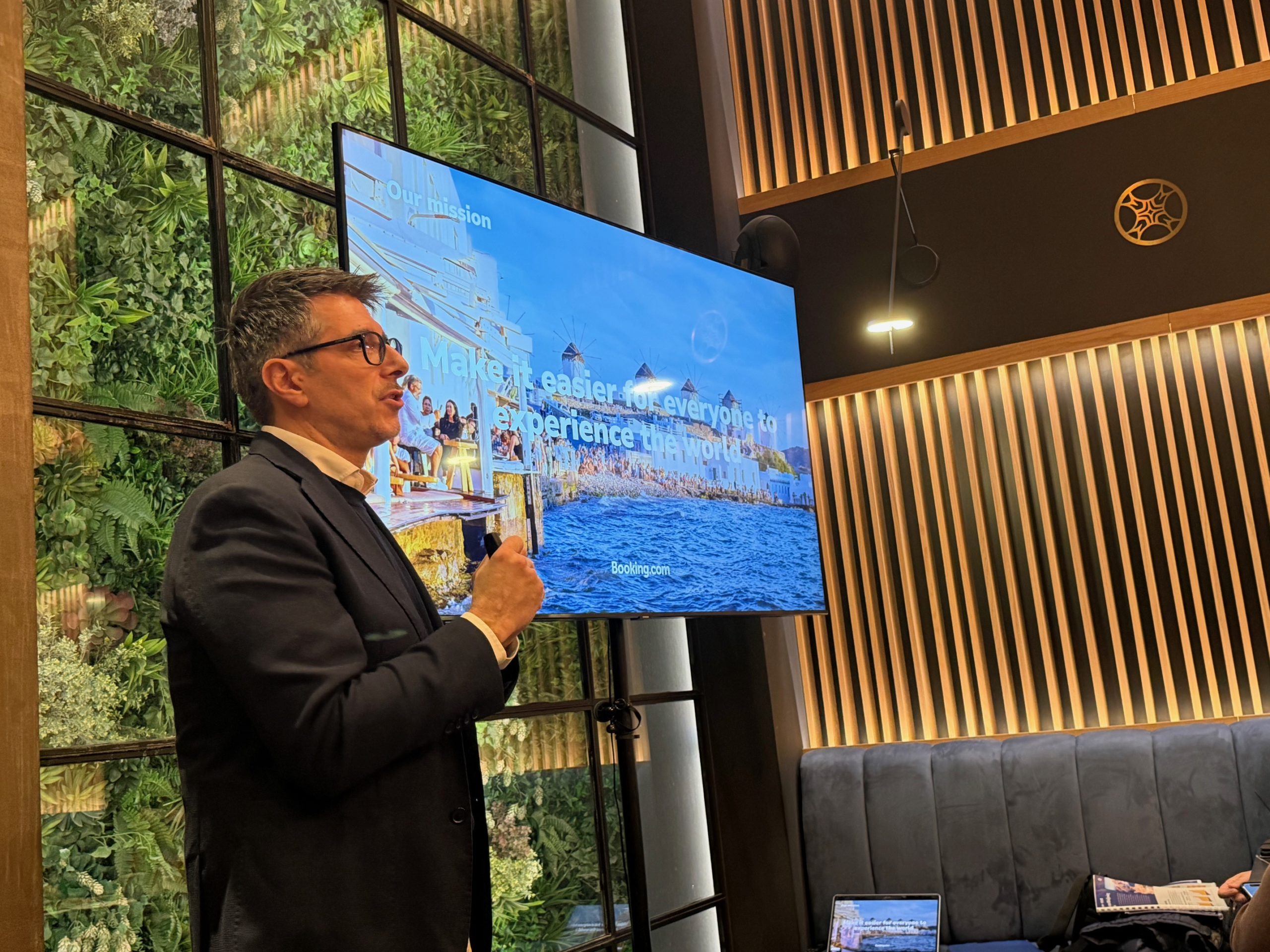
Greece is one of Booking.com’s most important and strategic destinations, with more than 100,000 partner accommodations, reflecting the importance of the Greek market in the platform’s international portfolio. The company has offices in Athens and Heraklion and employs 40 people, confirming its continued investment in the country. In this context, Alessandro Callari, the company’s Regional Manager for Italy-Greece-Malta-Israel, spoke extensively about developments at a press conference in Athens, highlighting the great potential Greece has in tourism and its tourism businesses.


When asked about HOTREC’s pan-European lawsuit, Alessandro Callari said: “Booking.com believes that these claims are unfounded. Despite what has been reported in some media outlets, the lawsuits involve a limited number of European hotels — approximately 3,000 — which is less than 0.1% of our more than 2.3 million partners in Europe and is based on a misinterpretation of previous court rulings.

We remain focused on what we do best: providing additional business activity to all our partners, large and small, by giving them the ability to reach a global audience in a transparent and cost-effective way, while supporting local economies throughout Europe.” And he added regarding the allegations that Booking’s commissions have “skyrocketed” and that the platform imposes “anti-competitive practices”: “These claims are inaccurate and misleading. Booking.com has not increased its commission for more than a decade, with the global average remaining at around 15%. The equivalence clauses no longer apply in the European Economic Area (EEA) and were abolished in 2024 as part of compliance with the Digital Markets Act. All optional tools and display programs can be activated or deactivated by partners, depending on their strategy. Booking.com does not set prices. “It only gets paid when its partners make paid bookings, ensuring a fully transparent return on investment.”
Regarding the court ruling in Berlin, he said: “We are satisfied that the Berlin court accepted key aspects of our position and rejected some of the claims. This decision pertains to previous parity clauses in Germany from 2006 to 2016 and exclusively addresses the issue of liability — not compensation. We maintain that our practices at the time did not violate competition law and, importantly, benefited both travelers and partners by increasing price competition and market transparency. Booking.com has consistently enabled partners to reach a global audience, increase their exposure, and develop their business through a flexible, risk-free model. The decision of the Berlin Court does not comment on or evaluate our ranking algorithms or promotional programs. Focuses exclusively on historical price parity clauses that were in effect during the period 2006–2016.”
And he concluded by saying: “The decision of the Berlin Court exclusively concerns historical price parity clauses that were applied in Germany during the period 2006–2016. Booking.com removed these clauses in Germany in 2016 and then throughout the European Economic Area as part of its compliance with the European Digital Markets Act. The decision addresses the issue of liability for past practices and does not impose any changes to our current business model or promotional programs. We continue to operate in full compliance with the current European regulatory framework, with a steadfast commitment to providing transparent and flexible tools that help our partners develop their business activities.”
The Barometer
At the same time, he presented the Booking.com Hospitality Barometer 2025, conducted in collaboration with Statista, which shows a significantly improved image for Greek tourism, with industry business owners appearing more optimistic than ever, exceeding the European Union average for the first time in key indicators.
75% of businesses rate their current financial situation as “(very) good,” up from 46% in the previous measurement, while 85% expect the next few months to be positive. Overall, 70% rate the past development positively, 75% rate the current situation positively, and 85% rate the future prospects positively, confirming a strong climate of confidence.
At a pan-European level, hotel chains consistently show stronger performance in all indicators, from financial situation to price and occupancy trends, compared to independent hotels and alternative accommodations, which are more restrained. Despite these differences, investment intentions remain stable for the market as a whole, with the vast majority of businesses planning to maintain the investment levels of the last six months.
Strong demand is also reflected in the key performance indicators. 55% of businesses report an increase in average daily rate (ADR), while only 3% report a decrease. Similarly, 41% report an increase in occupancy, compared to 8% who report a decrease. At the same time, access to financing appears to have improved, with 53% of entrepreneurs stating that they do not face difficulties, compared to just 20% in the previous survey, while 18% still consider it difficult.
The structure of the sector remains mostly independent, with 64% of businesses operating outside of chains and 36% belonging to organized schemes. 98% of these are hotels and similar accommodations, while only a small percentage are related to alternative forms of accommodation. In terms of categorization, 4-star hotels are the most common, with a 61% share, followed by 3-star hotels (13%), 5-star hotels (8%), 2-star hotels (3%), and 1-star hotels (1%), while 15% do not have an official rating.
The geographic distribution of accommodations shows a strong dependence on coastal tourism, as 94% are located in coastal areas. At the same time, 44% are active in rural areas, 40% in cities with up to 250,000 residents, 9% in cities with between 250,000 and 500,000 residents, 8% in large urban centers, and only 4% in mountainous areas. In terms of employment, 20% of businesses employ up to 9 workers, 31% from 10 to 49, 34% from 50 to 249, and 15% over 250.
The desire for hiring is particularly strong, with Greek businesses planning an average of 1.3 new positions in small units and 8.8 in larger ones, while 85% express positive expectations for the development of employment. However, finding staff remains one of the biggest challenges. The main obstacles recorded are high salary expectations (61%), difficulty achieving a balance between professional and personal life (69%), concerns about job stability (58%), limited opportunities for advancement (53%), a negative image of the industry (51%), lack of skills (49%), language barriers (41%), and long commutes (40%).
The greatest demand is for positions in housekeeping (73%), food and beverage (53%), and front desk (37%), while the hardest positions to fill are those in management (9.6), sales and marketing (4.5), spa and leisure (4.1), and event planning (3.6). In contrast, greater staff availability is reported in housekeeping and security.
In the area of training, Greece is more active than the European average. 64% of businesses provide training with structured guidance (compared to 56% in the EU), 60% implement personal training programs (28% in the EU), while 38% implement guidance or mentoring programs. Furthermore, 41% collaborate with hospitality or vocational training schools (34% in the EU), 30% offer financial support for further education (25% in the EU), and 25% utilize third-party training programs (22% in the EU) .
Regarding investment plans for employee development, 19% of Greek companies say they will increase their investments, 63% will maintain current levels, 5% will reduce them, 11% are not investing, and 3% say they do not know.
The adoption of technology and artificial intelligence is also a key focus, although it is accompanied by significant obstacles. High implementation costs are cited by 66% of businesses, integration complexity by 64%, lack of information on available solutions by 56%, data security concerns by 50%, lack of technical expertise by 46%, uncertainty about return on investment by 45%, and staff resistance by 26%.
Despite the obstacles, businesses recognize significant benefits from artificial intelligence, particularly in marketing and communications (78%), customer service (73%), pricing and revenue management (69%), fraud prevention and security (63%), improving the visitor experience (61%), energy and sustainability management (55%), staff training (50%), and operations planning (40%).
Seasonality and rising costs remain critical issues. To address seasonal fluctuations, businesses primarily implement promotions and special packages (74%), adjust pricing (73%), demonstrate flexibility in staff management (65%), collaborations with local businesses (53%), organizing events (50%), investing in weather-independent infrastructure (44%), revenue diversification (34%), and expanding into new markets (33%).
To cope with rising costs, 74% are raising prices, 53% are renegotiating supplier contracts, 51% are investing in technology to improve efficiency, 48% are accepting lower profit margins, another 48% are relying on increased demand to offset costs, 45% are reducing staff or working hours, 39% are targeting higher-spending customers, and 33% are making service adjustments.
Overall, the 2025 Hospitality Barometer shows Greek tourism in a phase of strong growth and increased confidence, with high demand and investment stability. However, structural challenges in the labor market, operating costs, and seasonality remain key factors for the sustainability of growth in the coming years.